How much food
is on your plate?
Here’s a food riddle:
{
When is a portion the same
as a serving?
}
Only when they’re equal.
A portion is how much food you
choose to eat at one time.
A serving is a standard unit of
measurement listed at the top of
a product’s Nutrition Facts label.
Based on guidelines set by the
U.S. Food and Drug Administration,
the serving size lets you know how
many calories and how much fat,
sodium and other nutrients are in
that measured amount of food.
Portions and servings aren’t
always equal. A serving of bread,
for example, is usually one slice.
A typical portion, however, is two
slices for a sandwich.
But knowing the serving size of
any food can help you assess the
amount of fat and calories in your
portion. That can give you the an-
swer to a different food question:
Am I overeating?
A growing problem
According to the American Insti-
tute for Cancer Research (AICR),
food portions in the U.S. have
grown considerably over the last
few decades.
It started when fast-food chains
began offering value meals and
super-size menu items. Competing
restaurants joined in, and soon
this portion distortion spread to
the home. Even our dinnerware got
bigger, with plates growing from
about 8 inches across to as much
as 12 inches now.
Today, Americans eat about
250 more calories daily than we
did four decades ago, reports the
AICR. That translates to an extra
26 pounds of body weight every
year.
To bring your portions into per-
spective, check out the nutrition
label on a favorite food.
Then measure one serving and
place it on your plate or in your
bowl. Take a good, long look at it.
Do that for other foods before you
eat them too.
It won’t be long before you’ll be
able to assess reasonable portions
at a glance.
Additional sources: Centers for Disease Control and
Prevention; National Institutes of Health
nhealth.com
and sign up for our free
My Health
e-newsletter.
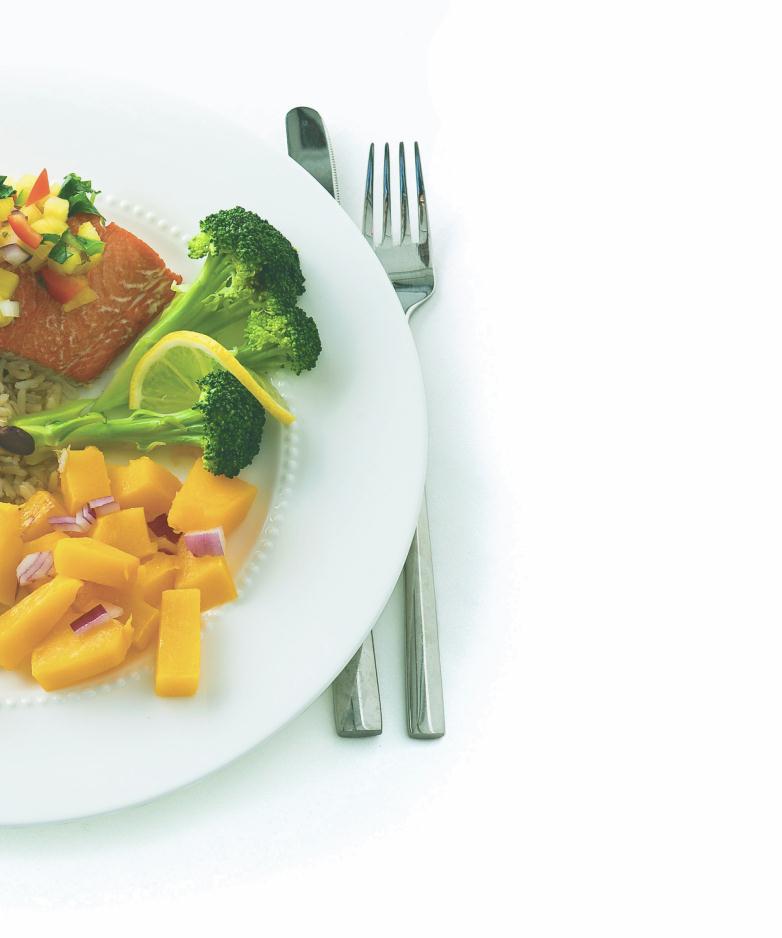
Salmon is also low in contaminants like mercury.
Salsas can be a healthy mix of chopped fruits,
vegetables and herbs. Te pineapple in this one adds
a bit of exotic zing. Look for fresh pineapple when
possible, but canned is fne if it’s packed in its own
juice without added sugars.
BROCCOLI GARNISHED WITH A LEMON TWIST
Dark green vegetables like broccoli are natural reservoirs
of calcium. Broccoli also is a cruciferous veggie. Tat
means it contains hard-to-pronounce but healthy com-
ponents like glucosinolates, which are linked to a reduced
risk for mouth, esophagus, stomach and other cancers.
Lemon, a citrus fruit, is high in vitamin C. It serves
double duty here by replacing salt as a favoring on the
broccoli. High-sodium diets are associated with high blood
pressure and a higher risk for heart disease and stroke.
Any time you can season with spices, herbs or citrus
juice, do it—and give the saltshaker a rest.
YELLOW SQUASH WITH RED ONION
Dotting
your plate with diferent colors of vegetables not
only makes it more appetizing, but it also makes
your meal more likely to contain a wide variety of
nutrients. One vegetable may be high in potassium
and vitamin A, while another may be bursting with B
vitamins. Te merrier the mix, the healthier the meal.
F A L L 2 0 1 1
5
H E A L T H B E A T