
F
a m i l y
H
e a l t h
YOUR BONES:
HOW STRONG
ARE THEY?
A DXA test may have the answer
TO FIND OUT
if your bones are healthy, your doctor
may recommend that you undergo a bone density test.
Te most common bone density test is the dual-energy
x-ray absorptiometry (DXA) test. It’s a test, similar to an
x-ray, that measures the bone density in your hip or spine.
Te DXA test can tell you if you have normal or low
bone density or if you have osteoporosis—a bone disease
associated with an increased risk of fracture.
Te lower your bone density, the greater your risk of
breaking a bone. A bone density test can help determine:
●
●
If you have weak bones or have osteoporosis (before
or afer you break a bone).
●
●
Your chances of breaking a bone in the future.
●
●
If your bone density is improving, getting worse or
staying the same.
●
●
How well an osteoporosis medicine is working.
During a bone density test, you usually remain fully
dressed. Te test typically takes about 15 minutes, involves
no needles and is painless.
Not everyone needs to have a bone density test. Accord-
ing to the National Osteoporosis Foundation, you should
consider a DXA test if you:
●
●
Are a woman 65 or older or a man 70 or older.
●
●
Break a bone afer age 50.
●
●
Have back pain with a possible break or bone loss in
your spine.
●
●
Have lost a ½ inch of height within a year or have a
total height loss of 1½ inches from your original height.
Te results of a DXA test are usually compared to the
ideal bone density of a healthy 30-year-old. Your results
may also be compared to a person your age.
If your test results show you have low bone density,
your doctor can make recommendations about what you
can do to reduce your chances of breaking a bone or get-
ting osteoporosis.
Additional source: National Institutes of Health
DXA scans are available at
the Shannon Women’s Imaging
Center. Call 325-481-2339.
HOW BEST TO
DEAL WITH A
CHILD’S FEVER
WHEN YOUR CHILD
has a fever, do you know what
to do? Some parents rush to treat a child’s fever, even
when it’s relatively mild. But according to experts, there
are times when treatment is not needed.
A FEVER’S JOB
Fever is not an illness itself, but a
symptom. And a fever serves a purpose. It can:
●
●
Keep the germs causing the illness from growing or
reproducing.
●
●
Stimulate the body’s immune response.
●
●
Help the body recover faster from viral infections.
Additionally, there’s no evidence that kids with fevers
are at any increased risk of complications such as brain
damage. In fact, for other-
wise healthy kids, a fever
typically poses no danger,
says the American Academy
of Pediatrics (AAP).
With that in mind, par-
ents don’t need to worry
about treating every fever
that comes along. Instead,
the main goal should be to
keep the child comfortable.
FEVER TIPS
Instead of
medicine, parents can usu-
ally opt for watchful waiting. Be sure your child is drink-
ing plenty of fuids, and watch for signs of serious illness.
If your child is uncomfortable and you decide to use
a fever reducer, keep in mind these tips from the AAP:
●
●
Opt for either ibuprofen or acetaminophen. Don’t use
aspirin—it can trigger a potentially dangerous condition
in children called Reye’s syndrome.
●
●
Don’t wake your child to give him or her a dose of
fever-reducing medicine.
●
●
Safely store fever reducers (and all medicines) out of
reach of children.
Your doctor can give you more advice about fevers.
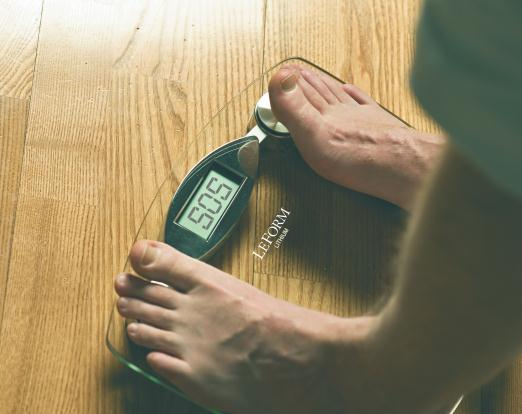
WHEN YOU PLANNED
your weight-loss strategy,
you might have started with your supersized self up at
Point A, your svelte future self down at Point B and then
joined the two points with a crisp, downward diagonal
line, symbolizing the pounds you planned to lose.
On paper, such a plan looks great. Of course, in real
life, that line might become more of a squiggle, but that’s
fne as long as it generally trends down.
But what happens if it doesn’t? What happens if your
weight-loss plan fatlines? Dietitians call it a plateau. If
you’ve reached one, you’re taking in just enough calories
to ofset the calories you burn.
EAT LESS, DO MORE
Getting back on the losing track
is all about fne-tuning, says Ruth Frechman, a registered
dietitian and spokeswoman for the American Dietetic
Association. “Maybe you could exercise more. Maybe
you could eat a little less.”
Start by looking at your food intake. “Every little extra
bite adds up,” Frechman says.
Tere are lots of ways to trim a few calories. For
example, switch to fat-free or low-fat dairy products.
If you’re eating out, consider a low-cal appetizer or two
instead of a complete entrée. You might also try to add
more fber to your diet, which will help you feel full longer.
Exercise is the other half of the equation. Aim for at
least 30 minutes of moderate activity most days of the
week. If you’ve already reached that goal, consider boost-
ing the intensity level of your exercise.
“You have to kick it up a notch,” Frechman says. If
you’re using a treadmill, increase the incline. If you’re
walking outside, hike uphill.
It’s also a good idea to add strength training to your
routine. Working out with weights two or three days a
week builds muscle, and muscle burns more calories than
other types of tissue.
Finally, if your weight-loss plan has stalled, consider
talking with a registered dietitian. He or she can help you
spot what’s keeping you from reaching your goal.
Frechman’s advice: Be patient and consistent.
“You’re not on a diet—this is a lifestyle,” she says. “If
you keep at it, you’re going to keep slowly losing weight.”
HIT A WEIGHT-LOSS PLATEAU?
FOLLOW THIS RESCUE PLAN
F A L L 2 0 1 1
3
H E A L T H B E A T